Last weekend, I read Rich Dad, Poor Dad. The book is about the financial skills that the rich pass on to their children, while everyone else struggles all their lives. After reading the book, I decided to open an E*Trade account and start investing.
You might be thinking that I just made a big mistake. I'm a college student with a $10 an hour internship. I have nothing to invest with, and I'm about to be hit with a lot of post-graduation costs. The economy is in the failing and the stock market is in the gutter.
But actually, this is the perfect time for me to start investing. If you've been paying attention to the news, the stock market has been rising these past two weeks. America's favorite indicator, the Dow Jones Industrial, made a net gain of almost 20% over the past two weeks. If we've seen the bottom and are starting to climb up, this is the perfect time to invest. And even though I'm on a tight budget, I'm fortunate enough to have parents that can pay my rent while I'm in school. I'll graduate with no debt. My income is low, but my expenses are even lower. I'm used to living on a tight budget, so instead of buying luxuries once I find a job, I'm going to put some of my money into stocks. But right now, I'm investing $200.
The best thing that could happen is that my $200 grows with the economy, and I start building a strong financial base. The worst thing that could happen is I lose the $200. But as long as I learn why I lost the money, it will be a valuable lesson.
Wednesday, March 25, 2009

Friday, March 20, 2009
Masters of Propaganda: Norman Osborn
He's the archenemy to one of America's most popular superheroes. He was the antagonist in 2002's highest-grossing movie. He's a psychopathic, murdering supervillain. But he's also a brilliant inventor, a successful businessman, well-connected, and currently the top cop in the Marvel universe. He's Norman Osborn and he's a Master of Propaganda.
To fully explain this, I'm going to throw some geekery at you. But don't worry; I'll explain everything you need to know, and I'll only mention characters that have been in movies in the past few years.
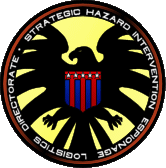 A few years ago, the US government in the Marvel universe passed the Superhuman Registration Act (SHRA). This new law required superheroes to register their identity with the government and receive training. Once trained, they had the option of working as an official law enforcement agent. In exchange for a government paycheck and support, registered heroes would have oversight and accountability. While many accepted this new law, other superheroes declared it an infringement on their freedoms and refused to "sell out" to "the man."
Enforcement of the act was delegated to SHIELD, an international intelligence agency and peace-keeping force. Tony Stark, the superhero Iron Man and CEO if Stark Industries, was the most public supporter of the SHRA. Eventually, Stark was appointed Director of SHIELD. To help capture the renegade heroes, Stark recruited the Thunderbolts, a team of supervillains seeking redemption. The reorganized team consisted of villains such as Venom, Bullseye, and Norman Osborn (the Green Goblin) as the leader.
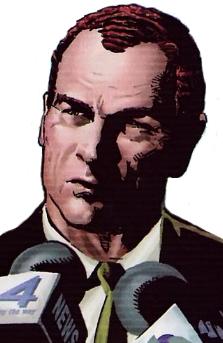 Osborn put a lot of thought into the roster and look of the new team. The previous leader was deemed unreliable, but was kept on the team because she was known to the public, "passably attractive," and "toyetic." A Chinese villain with radiation powers was given a hazard suit to calm unfounded fears and hide his ethnicity. Bullseye, a known murderer, was kept secret from the public.
We don't see Osborn's public relations work directly, but we see the results. News shows discussed the threat of "unregistered combatants" and cast a positive light on the Thunderbolts. A series of toys based on the team was launched, and advertisements portrayed the Thunderbolts as heroes protecting the public from dangerous, unregistered vigilantes.
Osborn and his new field leader also spun negative events in a positive fashion. When the Thunderbolts nearly botched a mission against a relatively weak hero, the field leader pointed out that this established unregistered heroes as a dangerous threat and justified the existence of the Thunderbolts. After Venom bit off a resisting hero's arm, Osborn allowed it to become public knowledge to intimidate other unregistered heroes.
At one point, a group of captured telepaths made the Thunderbolts go crazy and turn on each other. Even Osborn donned his Green Goblin armor and attacked members of his team. Once the crisis was averted, Osborn explained that the Green Goblin's appearance was a hallucination created by the telepaths, and that eyewitness accounts of the incident could not be trusted. However, a psychiatrist that had been present during the attack managed to steal security footage of the event.
Osborn's greatest opportunity came during an alien invasion. The aliens shut down all technology created by Stark Industries, including most of SHIELD's equipment. Since the Thunderbolts were using Oscorp technology, they were unaffected and Osborn rushed them to Washington, DC. There, the Thunderbolts publicly defended civilians and national monuments in front of news cameras. During a break in the battle, Osborn gave an interview criticizing Stark. When the invasion was finally averted, Osborn was portrayed as the hero who saved the world. In the aftermath, the US President dismantled SHIELD and charged Osborn with replacing it.
To be continued...
To fully explain this, I'm going to throw some geekery at you. But don't worry; I'll explain everything you need to know, and I'll only mention characters that have been in movies in the past few years.
A few years ago, the US government in the Marvel universe passed the Superhuman Registration Act (SHRA). This new law required superheroes to register their identity with the government and receive training. Once trained, they had the option of working as an official law enforcement agent. In exchange for a government paycheck and support, registered heroes would have oversight and accountability. While many accepted this new law, other superheroes declared it an infringement on their freedoms and refused to "sell out" to "the man."Enforcement of the act was delegated to SHIELD, an international intelligence agency and peace-keeping force. Tony Stark, the superhero Iron Man and CEO if Stark Industries, was the most public supporter of the SHRA. Eventually, Stark was appointed Director of SHIELD. To help capture the renegade heroes, Stark recruited the Thunderbolts, a team of supervillains seeking redemption. The reorganized team consisted of villains such as Venom, Bullseye, and Norman Osborn (the Green Goblin) as the leader.
Osborn put a lot of thought into the roster and look of the new team. The previous leader was deemed unreliable, but was kept on the team because she was known to the public, "passably attractive," and "toyetic." A Chinese villain with radiation powers was given a hazard suit to calm unfounded fears and hide his ethnicity. Bullseye, a known murderer, was kept secret from the public.We don't see Osborn's public relations work directly, but we see the results. News shows discussed the threat of "unregistered combatants" and cast a positive light on the Thunderbolts. A series of toys based on the team was launched, and advertisements portrayed the Thunderbolts as heroes protecting the public from dangerous, unregistered vigilantes.
Osborn and his new field leader also spun negative events in a positive fashion. When the Thunderbolts nearly botched a mission against a relatively weak hero, the field leader pointed out that this established unregistered heroes as a dangerous threat and justified the existence of the Thunderbolts. After Venom bit off a resisting hero's arm, Osborn allowed it to become public knowledge to intimidate other unregistered heroes.
At one point, a group of captured telepaths made the Thunderbolts go crazy and turn on each other. Even Osborn donned his Green Goblin armor and attacked members of his team. Once the crisis was averted, Osborn explained that the Green Goblin's appearance was a hallucination created by the telepaths, and that eyewitness accounts of the incident could not be trusted. However, a psychiatrist that had been present during the attack managed to steal security footage of the event.
Osborn's greatest opportunity came during an alien invasion. The aliens shut down all technology created by Stark Industries, including most of SHIELD's equipment. Since the Thunderbolts were using Oscorp technology, they were unaffected and Osborn rushed them to Washington, DC. There, the Thunderbolts publicly defended civilians and national monuments in front of news cameras. During a break in the battle, Osborn gave an interview criticizing Stark. When the invasion was finally averted, Osborn was portrayed as the hero who saved the world. In the aftermath, the US President dismantled SHIELD and charged Osborn with replacing it.
To be continued...
Wednesday, March 11, 2009
Happy Friday the 13th!
Earlier this week, I had a dream about a new TV show: CSI: Chicago. Due to intimidation by gangs and corruption in law enforcement, half the crimes in the first few episodes will go unsolved. However, criminals manage to avoid punishment for the cases that are solved. I also had an idea for CSI: Detroit, where the cast is to scared to even leave the station.
Tomorrow is Friday the 13th. To most Americans, this is an unlucky day, especially if your significant other is a big fan of the movies and her high school friends had a tradition of watching one of them every time there was a Friday the 13th, and now that she's in college she expects you to watch those generic slasher films. Really? You think a guy in a hockey mask is scary? There are so many better movies out there, and you want to watch these?

But I digress. Unlike most Americans, I'm not afraid of Friday the 13th. In fact, I consider it a great day. In Judaism, Friday is the day before the sabbath. It's a chance to prepare for the day of rest and relax. In Israel, the weekend is Friday and Saturday. So Friday is not a bad day.
The number thirteen is a little more complex to explain. First, we need to understand why Christianity considers thirteen unlucky:
So have a happy Friday the 13th. I know I will!
Tomorrow is Friday the 13th. To most Americans, this is an unlucky day, especially if your significant other is a big fan of the movies and her high school friends had a tradition of watching one of them every time there was a Friday the 13th, and now that she's in college she expects you to watch those generic slasher films. Really? You think a guy in a hockey mask is scary? There are so many better movies out there, and you want to watch these?
But I digress. Unlike most Americans, I'm not afraid of Friday the 13th. In fact, I consider it a great day. In Judaism, Friday is the day before the sabbath. It's a chance to prepare for the day of rest and relax. In Israel, the weekend is Friday and Saturday. So Friday is not a bad day.
The number thirteen is a little more complex to explain. First, we need to understand why Christianity considers thirteen unlucky:
In numerology, the number twelve is considered the number of completeness, as reflected in the twelve months of the year, twelve signs of the zodiac, twelve hours of the clock, twelve tribes of Israel, twelve Apostles of Jesus, twelve gods of Olympus, etc., whereas the number thirteen was considered irregular, transgressing this completeness. There is also a superstition, thought by some to derive from the Last Supper or a Norse myth, that having thirteen people seated at a table will result in the death of one of the diners. (source)Judaism has no unlucky numbers. But some numbers are luckier than others. Twelve is also recognized as a natural number. But adding one more makes it "extra-natural" or even "supernatural." Boys have their Bar Mitzvah (the coming of age ceremony) at the age of thirteen. For the same reason, boys are circumcised and named on the eight day after their birth - seven is a "natural" number, so eight is the supernatural counterpart. So thirteen is a number to be celebrated, not feared.
So have a happy Friday the 13th. I know I will!
Thursday, March 5, 2009
Masters of Propaganda: Virgil
Most people think that the father of public relations was Edward Bernays. But the origin of PR is much older by almost 2000 years!
In 44 BC, Julius Caesar was a little power-hungry and got assassinated. Rome spent the next fifteen years indulging in its second favorite pastime, civil war. Eventually, Julius' adopted son, Gaius Julius Caesar Octavius, emerged as Rome's first official emperor, Augustus.
But Augustus had some image problems. Romans were wary of kings, and Augustus had to convince people that he had a right to be in charge of everything. Additionally, Romans were feeling a little inadequate. Barely five hundred years old, Rome had very little history or original mythology. Compared to Greece, Rome looked like an uncultured upstart.
So in 29 BC, the poet Virgil began composing The Aeneid. The epic tells the story of Aeneas, a Trojan prince who escapes the burning city as the Greeks are pillaging it. Aeneas and the other refugees travel around the Mediterranean, piss off Carthage, and finally settle in Italy, becoming the Latins. Virgil takes every opportunity to point out that Aeneas is the son of Venus, the goddess of love. He also explains that Iulus, Aeneas' son, is the source of the Julian clan - the family of Julius Caesar, and the adopted family of Augustus.
Virgil died upon completing the epic, but The Aeneid became a popular tale. The Romans were actually the descendants of the Trojans, and therefore had a history as old as those snobby Greeks. And the Punic Wars were not just a trade dispute, but the culmination of an ancient rivalry. And their new emperor wasn't some tyrant, but the descendant of the hero Aeneas and the goddess Venus!
So what can we learn from Virgil, the father of public relations, the master of propaganda? If you want to make your client look good, find a way to link them to a heroic past. The GOP likes to point out that Lincoln was a Republican, while Democrats idolize FDR and JFK. Old companies worship their founders.
The other lesson is to link the audience to your client. Virgil made an implicit deal with Roman audiences: "If you accept that Augustus has a right to be emperor, you can have a glorious history. But if you reject Augustus' pedigree, then deny yourself of greatness." Philosophers know this as the "appealing to vanity" fallacy.
Virgil never crafted press releases, organized events, or did any of the other things modern public relations professionals do. But he improved the image of Augustus and made Romans proud of their heritage. That is why Virgil is our first Master of Propaganda.
In 44 BC, Julius Caesar was a little power-hungry and got assassinated. Rome spent the next fifteen years indulging in its second favorite pastime, civil war. Eventually, Julius' adopted son, Gaius Julius Caesar Octavius, emerged as Rome's first official emperor, Augustus.
But Augustus had some image problems. Romans were wary of kings, and Augustus had to convince people that he had a right to be in charge of everything. Additionally, Romans were feeling a little inadequate. Barely five hundred years old, Rome had very little history or original mythology. Compared to Greece, Rome looked like an uncultured upstart.
So in 29 BC, the poet Virgil began composing The Aeneid. The epic tells the story of Aeneas, a Trojan prince who escapes the burning city as the Greeks are pillaging it. Aeneas and the other refugees travel around the Mediterranean, piss off Carthage, and finally settle in Italy, becoming the Latins. Virgil takes every opportunity to point out that Aeneas is the son of Venus, the goddess of love. He also explains that Iulus, Aeneas' son, is the source of the Julian clan - the family of Julius Caesar, and the adopted family of Augustus.
Virgil died upon completing the epic, but The Aeneid became a popular tale. The Romans were actually the descendants of the Trojans, and therefore had a history as old as those snobby Greeks. And the Punic Wars were not just a trade dispute, but the culmination of an ancient rivalry. And their new emperor wasn't some tyrant, but the descendant of the hero Aeneas and the goddess Venus!
So what can we learn from Virgil, the father of public relations, the master of propaganda? If you want to make your client look good, find a way to link them to a heroic past. The GOP likes to point out that Lincoln was a Republican, while Democrats idolize FDR and JFK. Old companies worship their founders.
The other lesson is to link the audience to your client. Virgil made an implicit deal with Roman audiences: "If you accept that Augustus has a right to be emperor, you can have a glorious history. But if you reject Augustus' pedigree, then deny yourself of greatness." Philosophers know this as the "appealing to vanity" fallacy.
Virgil never crafted press releases, organized events, or did any of the other things modern public relations professionals do. But he improved the image of Augustus and made Romans proud of their heritage. That is why Virgil is our first Master of Propaganda.
Subscribe to:
Comments (Atom)
